How we choose what to recommend.
ParentCareGuide is editorially independent. Picks come from published-spec research and verified buyer-review patterns at 4.0+ stars across 200+ reviews. We are not paid by manufacturers for placement and have not received free product from any brand listed.
Disclosure: Amazon affiliate links, we earn 2–4% commission at no extra cost. How we choose → · Affiliate disclosure →
Nighttime is the highest-risk time for falls. Your parent gets up at 2 a.m., groggy, unsteady, possibly needing the bathroom urgently, and there's nothing stable to hold onto. A properly installed bed rail or bedside assist handle can be the difference between a safe transfer and a devastating fall. The right device installed correctly is simple, affordable, and genuinely protective.
We reviewed eight of the most trusted bed rails and safety rails for elderly adults, evaluating each for how securely it anchors to the mattress or bed frame, how much grip support it provides, whether it folds out of the way during the day, and whether the design poses any entrapment risks, a critical safety consideration for seniors.
Quick Comparison: 8 Best Bed Rails 2026
| Product | Type | Weight Limit | Price | Best For |
|---|---|---|---|---|
| Stander EZ Adjust | Half rail with handle | 300 lbs | Under $250 | Best overall stability and features |
| DMI Bed Assist Rail | Assist handle | 250 lbs | Under $100 | Compact assist handle, easy install |
| PELEGON Bed Rail | Adjustable rail | 300 lbs | Under $50 | Rail with handle and storage pocket |
| Medline Bed Assist Bar | Assist handle | 300 lbs | Under $50 | Best budget option |
| Stander BedCane | Floor-standing cane | 300 lbs | Under $100 | Adjustable height, no mattress anchor |
| BigDolphin Bed Rail | Adjustable rail | 350 lbs | Under $50 | Sturdy mid-price rail for standard beds |
| Yetulike Bed Assist Rail | Assist handle | 300 lbs | Under $100 | Anchor strap, fits most beds |
| Able Life Extend-A-Rail | Adjustable rail | 300 lbs | Under $100 | Most versatile, adjustable length |
The 8 Best Bed Rails for Elderly Adults, Detailed Reviews
Stander EZ Adjust Bed Rail
 Best for: Most seniors needing comprehensive bedside support
The Stander EZ Adjust earns the top overall recommendation for combining the features that matter most: solid anchoring without tools, an adjustable rail length that fits different bed sizes, a convenient organizer pocket for keeping glasses, phone, and medications within reach, and a handle that feels genuinely stable when your parent pushes off it to stand. It carries ASTM safety approval.
Installation requires sliding the support bar between the mattress and box spring, with no tools, no hardware, and no bed frame modifications. The rail extends in length to span more of the bedside, and it folds down during the day to reduce snag risk. At under $250 it is the best combination of features, safety certification, and proven brand reputation in this category.
Pros
- Tool-free installation, no hardware
- Rail length adjusts to the bed
- Organizer pocket for essentials
- Folds down during day
- ASTM safety approved
Cons
- Not compatible with adjustable beds
- Box spring required for proper anchoring
- May shift on very thick pillow-tops
DMI Bed Assist Rail with Adjustable Handle
 Best for: Parents who need grip support without a full rail
The DMI Bed Assist Rail is for parents who need a secure grip point for the sit-to-stand transition but do not need the full panel of a half rail. Per the listing it is an all-steel frame that slides between mattress and box spring, with a padded handle that adjusts from 30.5 to 38 inches high and slip-resistant floor tips. Weight capacity is 250 pounds.
The three steel sections slide together without tools, and it works on any size bed with a separate box spring, provided the box spring top sits 18 to 22 inches off the floor. At under $100 it is a practical, minimal solution that does not make the bedroom look like a medical supply room.
Pros
- Compact, unobtrusive design
- Padded handle
- Adjustable handle height
- Tool-free installation
Cons
- No organizer pocket or shelf
- Less panel support than a half rail
- Requires box spring for anchoring
PELEGON Bed Rail for Elderly Adults
 Best for: Parents who want a rail and bedside storage in one
The PELEGON Bed Rail delivers a sturdy rail panel with a non-slip ergonomic handle, paired with a front-mounted storage pocket that holds a phone, glasses, TV remote, and water bottle within easy nighttime reach. This is a meaningful quality-of-life feature: if your parent keeps items on a nightstand they constantly struggle to reach, moving them to the rail pocket can reduce falls caused by nighttime stretching.
The steel frame anchors between mattress and box spring without tools, the design is ASTM compliant, and the 300 lb weight capacity accommodates most users comfortably. At under $50 it is an affordable, well-featured rail, making it a strong value choice or a good option if the Stander is out of budget.
Pros
- Non-slip ergonomic handle
- Storage pocket keeps essentials reachable
- 300 lb weight capacity
- ASTM compliant
- Tool-free install
Cons
- Requires box spring or compatible frame
- Not for platform beds
- Storage pocket slightly small
Medline Bed Assist Bar
 Best for: Families on the tightest budget who need basic assist function
The Medline Bed Assist Bar is the most affordable reviewed option that still provides reliable, safe grip support. For under $50, your parent gets a steel-frame assist handle that anchors between mattress and box spring, holds up to 300 lbs, ships with a storage bag, and provides a secure grip point for both sitting up in bed and the transfer to standing. Medline's quality control is generally better than no-name brands at similar prices.
The assist bar is basic by design, no organizer pocket, no padded rail, no fold-down feature. For a parent who needs minimal bedside support and where budget is the primary consideration, this does the job safely. It's also a practical choice as a backup rail at a second location, a relative's guest room during holiday visits, for example.
Pros
- Most affordable reviewed option
- Medline quality reliability
- 300 lb weight capacity
- Simple tool-free installation
Cons
- No organizer pocket or extras
- Less ergonomic handle than premium options
- No fold-down feature
Stander BedCane Floor-Standing Bed Rail
 Best for: Platform beds, adjustable beds, or beds without a box spring
Every other rail in this review anchors between the mattress and box spring. The Stander BedCane takes a completely different approach: it stands on a floor-level base plate that slides under the bed, requiring no mattress, no box spring, and no frame modifications. This makes it the only option in this review that works with platform beds, adjustable air beds, or any sleeping surface that does not have a box spring to anchor under. It includes an organizer pouch and is ASTM approved.
The handle adjusts in height to allow precise positioning at the ideal push height for your parent's specific body. At under $100 it is among the pricier options in this review, but for families where platform beds or adjustable beds make other options impossible, it is the right tool. Stander's build quality is excellent and the floor base is genuinely stable under body weight.
Pros
- Works on any bed type, no box spring needed
- Adjustable handle height
- No mattress anchoring required
- Solid floor-standing base
- Works with adjustable and smart beds
Cons
- Among the pricier options at under $100
- Floor plate may be a trip hazard if not monitored
- Takes more space than mattress-anchored options
BigDolphin Adjustable Bed Rail
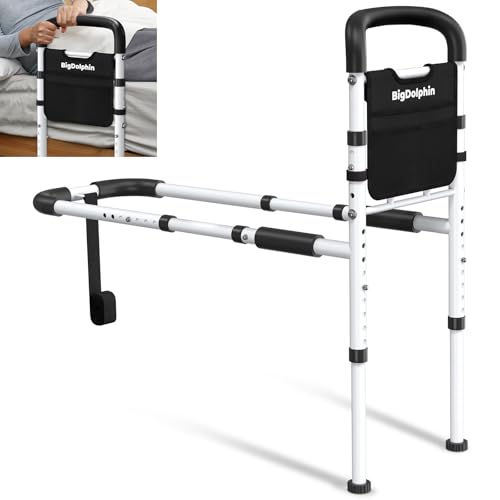 Best for: Families wanting a sturdy rail at a fair price
The BigDolphin Adjustable Bed Rail does its job reliably at a moderate price. The steel frame anchors under the mattress, the non-slip grip provides side support during transfers, and it holds up to 350 lbs, a higher capacity than many rails in this class. It is ASTM approved and includes a storage pocket for nighttime essentials.
At under $50, it positions itself between the budget Medline assist bar and the feature-rich Stander EZ Adjust. If your parent needs a stable rail with a higher weight rating and tool-free setup, the BigDolphin is a sensible, dependable choice.
Pros
- 350 lb weight capacity
- Non-slip grip for transfers
- Storage pocket included
- Tool-free install, ASTM approved
Cons
- No fold-down feature
- Requires box spring or compatible frame
- Newer brand, shorter track record
Yetulike Bed Assist Rail with Anchor Strap
 Best for: Added stability from a securing strap on any mattress width
The Yetulike Bed Assist Rail adds something many assist handles lack: an adjustable anchor strap that secures the frame for extra stability, plus adjustable legs that fit most bed sizes. Per the listing it is steel with an internal support, has a non-slip foam handle that extends from 22.4 to 29.9 inches, and meets ASTM bed rail standards. For families who want a grip point that stays put, it delivers at under $100.
The height adjusts to suit different bed and user heights, and the securing strap reduces the side-to-side shift that can make basic handles feel loose. Always verify the anchoring and strap are secure after installation, regardless of the product used.
Pros
- Anchor strap for stability
- Fits most bed sizes
- Height adjustable, ASTM listed
Cons
- No organizer pocket
- Single handle, not a full panel
- Basic styling
Able Life Bedside Extend-A-Rail
 Best for: Parents needing maximum panel length or adjustable coverage
The Able Life Extend-A-Rail stands out by offering adjustable rail length, something no other option in this review provides. The rail extends from a shorter position to a longer panel, which is valuable for parents who need support not just during the initial sit-to-stand transfer but also for stability while repositioning in bed before rising. The longer panel essentially provides a handrail along the mattress edge, and it is ASTM approved.
At under $100 it is among the premium options in this review, but the Extend-A-Rail's versatility, sturdy build, and ASTM-approved safety justify the price for parents with significant mobility challenges. The tool-free under-mattress anchor is secure on standard beds and fits king, queen, full, and twin sizes.
Pros
- Adjustable rail length, a standout feature
- Longest panel coverage in this review
- ASTM safety approved
- Fits king, queen, full, and twin beds
- Tool-free under-mattress anchor
Cons
- Among the priciest at under $100
- Requires standard bed frame
- Larger, takes more space along mattress side
How to Choose the Right Bed Rail for an Elderly Parent
First: Identify Your Parent's Bed Type
This is the most important factor. Most bed rails require a box spring to anchor under the mattress. If your parent sleeps on:
- Traditional mattress and box spring: Any rail in this review will work
- Platform bed (no box spring): Only the Stander BedCane will work safely
- Adjustable bed or hospital bed: Only the Stander BedCane will work safely
- Very thick pillow-top (over 14 inches): May affect anchoring, check each product's specification
Next: Match to Your Parent's Needs
- Just needs a push point to stand: Assist handle (DMI, Medline) is sufficient
- Needs side support during bed repositioning: Half rail panel (Stander EZ Adjust, Vive, Able Life) is better
- Needs essentials within reach at night: Choose a rail with an organizer pocket
- Tall bed or high mattress: Confirm handle height reaches at usable level
Bed Rail Safety: What Every Caregiver Must Know
The FDA has issued specific guidance on adult bed rail safety. Key points for home caregivers:
- Avoid full-length restraint rails: Long rails designed to keep someone in bed are associated with entrapment between the rail and mattress. These are not the same as assistive bed rails and should be avoided.
- Check regularly for gaps: Inspect the installation weekly. Gaps between the rail and mattress that could trap a body part require immediate correction.
- Cognitive impairment caution: For parents with dementia who may not understand how to use the rail safely, consult with a healthcare provider before installing any bed rail.
- Never use a damaged rail: If any component bends, cracks, or loosens, replace the product before further use.
Affiliate disclosure. The product picks above are Amazon affiliate links. ParentCareGuide earns 2–4% commission when you buy through them, at no extra cost to you. We are editorially independent, manufacturers do not pay us for placement and we did not receive free product from any brand listed. Read our full disclosure →
Frequently Asked Questions About Bed Rails for Seniors
Are bed rails safe for elderly adults?
Assistive bed rails designed to help with getting in and out of bed are generally safe when properly installed and appropriately matched to the user. Full-length restraint rails (designed to keep people in bed) are not recommended for elderly adults at home due to entrapment risks. Always read installation instructions carefully and inspect the installation weekly.
Do bed rails work on all mattresses and beds?
Most standard bed rails anchor by sliding under the mattress and require a box spring below. They do not work with platform beds, adjustable beds, or beds with a solid foundation. For these bed types, a floor-standing bed cane like the Stander BedCane is the appropriate solution.
Can a bed rail help prevent nighttime falls?
Yes. A properly installed bedside assist rail or handle gives your parent a stable grip point for the sit-to-stand and stand-to-sit transitions that cause many nighttime falls. The rail also provides something to hold while repositioning in bed, reducing the risk of rolling. However, bed rails don't prevent all falls, ensure the path to the bathroom is also well-lit and clear of trip hazards.
What is the difference between a bed rail and a bed assist handle?
A bed assist handle (or assist bar) is a single grip point, essentially a handle your parent holds while transferring. A half rail provides a longer panel that offers support over a wider area along the mattress edge, useful for repositioning and transfers. For most seniors, either works well; for parents with significant trunk instability, the broader support of a half rail is preferable.
How high should a bed rail be?
The top of the rail handle should be at a height that your parent can comfortably reach from a lying position and push from during the sit-to-stand motion. Most standard rails position the handle 8 to 12 inches above the top of the mattress, which works for typical adult beds. For very tall beds or adjustable height beds, verify the specific measurements before purchasing.
Are bed rails covered by Medicare?
Medicare does not typically cover assistive bed rails purchased for home use. Some Medicaid waiver programs and Medicare Advantage plans may include home safety equipment coverage, check your parent's specific plan. Many bed rails are affordable enough ($30 to $100) that out-of-pocket purchase is practical for most families.
Should I use a bed rail for a parent with dementia?
Use caution. A parent with mild cognitive impairment can often safely use an assistive bed rail if taught how to use it. For parents with moderate to advanced dementia who may attempt to climb over the rail or become confused by it, consult with the physician and an occupational therapist before installing. An improperly used rail can create new hazards for those with cognitive impairment.
My parent has a very thick pillow-top mattress. Will a standard bed rail work?
Many standard bed rails specify they work with mattresses up to 10 or 12 inches deep. Memory foam and pillow-top mattresses often exceed this, which can prevent the under-mattress strap or board from anchoring securely. Check each product's stated mattress depth compatibility before purchasing. The Stander BedCane floor-standing model works regardless of mattress thickness.
Get the Complete Caregiver Toolkit
Includes home safety assessment checklists, nighttime safety guides, fall prevention strategies, and 40+ more resources for caring for an aging parent.
Get the Complete Toolkit for $39One more time, because this matters. Every product recommendation on this page is independent. We accept no manufacturer payment, no sponsored placement, and no free product in exchange for coverage. When you buy through an Amazon link here, we earn 2–4% commission, that's how we keep ParentCareGuide free to read. If a pick stops being our honest recommendation, we remove it. Our editorial standards → · Affiliate disclosure →