How we choose what to recommend.
ParentCareGuide is editorially independent. Picks come from published-spec research and verified buyer-review patterns at 4.0+ stars across 200+ reviews. We are not paid by manufacturers for placement and have not received free product from any brand listed.
Disclosure: Amazon affiliate links, we earn 2–4% commission at no extra cost. How we choose → · Affiliate disclosure →
Getting up from a standard toilet is one of the most strenuous activities in daily life for a senior with arthritis, hip replacement, knee problems, or general weakness. A raised toilet seat can reduce the strain of rising by 50% or more, and it's one of the most cost-effective safety modifications you can make to a parent's home. Under $50, no tools required for most models, and it can prevent a fall that leads to a hip fracture and months of recovery.
The market has a wide range of quality and safety, though. An unstable raised seat is more dangerous than no raised seat at all. We've evaluated these 8 options for security of fit, weight capacity, height addition, ease of cleaning, and whether arms are worth it for your parent's specific situation.
 Best overall with arms: Vive Raised Toilet Seat
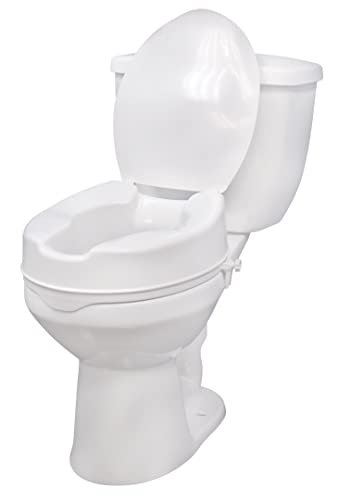 Best basic raised seat: Drive Medical Elevated Toilet Seat
 Best for portability: AquaSense Portable Raised Seat
 Best premium option: NOVA Raised Toilet Seat with Arms
 Best locking mechanism: Carex E-Z Lock
 Best fit for any toilet shape: HealthSmart Locking Raised Seat
 Best for heavier adults: HOMLAND Raised Seat with Handles
 Best value with arms: NOVA Toilet Seat Riser with Arms
The 8 Best Raised Toilet Seats for Seniors
The Vive Raised Toilet Seat is the most complete package at this price point. It adds 5 inches of height (appropriate for most seniors), has padded support handles on each side for safe pushing up, and supports up to 350 lbs. The locking bracket system attaches to the toilet rim to prevent the seat from shifting during use, a critical safety feature that cheaper seats omit.
Installation takes under two minutes with no tools. The medical-grade plastic is durable, easy to wipe down, and odor-resistant. The armrests provide meaningful leverage for pushing up from seated to standing, which is precisely what arthritic or weak seniors need. At under $100, it represents outstanding value for what is essentially a mobility aid that works every single day.
Pros
- Padded support handles for push-up
- Secure locking bracket prevents shifting
- 350 lb weight capacity
- Easy tool-free installation
- Outstanding price-to-value ratio
Cons
- Arms extend width, may not fit narrow bathrooms
- 5 inches may be more than needed for some users
Drive Medical is a respected healthcare equipment manufacturer whose products are used in hospitals and rehab facilities. Their elevated toilet seat is a simple, reliable, no-frills solution for seniors who need modest height assistance and don't require the support of armrests. At 4 inches, it provides the most commonly needed height increase without the bulk of taller models, and a secure locking attachment plus a snap-on lid keep it stable and tidy.
Available in versions for both standard round and elongated toilet bowls, make sure you select the correct shape for your parent's toilet. The smooth molded surface is hygienic and easy to wipe down. Without arms, it fits in tighter bathroom spaces and is a good choice when grab bars are already installed on nearby walls. At under $50, it is the most affordable quality option on this list.
Pros
- Most affordable quality option
- Healthcare-grade manufacturing
- Fits both standard and elongated toilets
- Slim profile, works in tight spaces
- Secure locking attachment with lid
Cons
- No armrests for push-up support
- Requires grab bars or nearby support
- Not suitable for parents who need arm support to stand
The AquaSense portable raised seat is designed with portability in mind, it installs and removes without tools in seconds, making it practical for seniors who travel, visit family, or need a seat that can move between bathrooms. The compact storage size means it fits in a travel bag without difficulty. Despite its portability focus, it doesn't sacrifice function: 3.5-inch height increase and solid construction for daily home use.
The installation system uses a simple under-rim grip mechanism that holds firmly during use but releases easily when you need to remove it for regular toilet use by other household members. A practical solution for multigenerational homes where not everyone needs the raised seat permanently.
Pros
- Quick tool-free removal and reinstallation
- Practical for travel or multi-user households
- Good 3.5-inch height addition
- Lightweight and packable
Cons
- No arm support
- Less stable than permanently mounted options
- Not suitable for parents who push hard to stand
NOVA is a well-respected medical equipment brand and their raised toilet seat with arms reflects careful attention to safety. The sturdy steel safety grab bars on each side give a genuine quality-of-life upgrade over no-arm seats, providing a confident push point for standing. The bars are positioned at the height and angle that matches how people naturally push themselves up.
The locking mechanism is one of the most secure designs on this list, it grips the toilet rim firmly with no wobbling. The 5-inch elevation combined with the steel grab bars and the ergonomic push-up position makes this a confident daily-use option. With a 300 lb weight capacity, it suits most users, but check your parent's weight before purchasing.
Pros
- Sturdy steel safety grab bars
- Ergonomically angled armrests
- Very secure locking mechanism
- Premium quality construction
- Good brand reputation in healthcare
Cons
- Seat is firm plastic, not padded
- Higher price than basic options
- Arms cannot fold up
The Carex E-Z Lock gets its name from its standout feature: a patented locking mechanism that snaps securely onto virtually any toilet rim with a satisfying click that confirms it's properly attached. There is no ambiguity about whether the seat is locked, you either hear and feel the click, or it isn't on properly. For caregivers who worry about whether a parent properly installed their seat after cleaning, this mechanical confirmation matters.
At under $50, the Carex E-Z Lock pairs that safety-first locking design with built-in padded grab-bar handles, so your parent has a sturdy push point on each side without needing separate wall-mounted bars. The security of the seat itself, no wobbling, no sliding, is excellent. A strong choice when locking confidence and arm support both matter.
Pros
- Patented E-Z Lock locking mechanism
- Audible click confirms proper installation
- No wobbling or sliding once locked
- Built-in padded grab-bar handles
Cons
- Bulkier than a no-arm riser
- Best fit on standard round toilets
- Pricier than basic risers
The HealthSmart Locking Raised Toilet Seat Riser is the most flexible fit on this list: its easy locking clamps grip the bowl securely and it fits both round and elongated toilets, so you do not have to measure or guess at the shape before buying. The included lid keeps it tidy between uses, and quick assembly means it is ready in minutes with no tools.
It adds a comfortable 4 inches of height and carries a generous 418 lb weight capacity, well above the 300 lb rating of most basic risers, which makes it a confident choice for larger adults who still want a clamp-on seat rather than a full safety frame. A practical, no-arms pick when the priority is a secure fit on an unknown or shared toilet.
Pros
- Fits both round and elongated toilets
- Secure easy-locking clamps
- High 418 lb weight capacity
- Includes lid; tool-free quick assembly
Cons
- No arm support
- Requires grab bars for push-up help
- 4-inch height may be more than some need
The HOMLAND Raised Toilet Seat with Handles is the heavy-duty solution for parents who need a seat rated beyond the 250-300 lb capacity of standard models. With a 400 lb weight capacity, reinforced frame, and sturdy support handles on both sides, it provides genuine stability for larger adults without the anxiety of a seat that flexes or creaks.
The height is adjustable and the frame fits virtually any toilet shape, round or elongated, so you do not have to match it precisely to your parent's bowl. The handles give a confident push point for standing. At under $100, it is one of the higher-priced options here, but for a parent who needs the extra weight capacity and arm support and will use it multiple times daily, it is a worthy investment in lasting, safe equipment.
Pros
- 400 lb weight capacity for larger adults
- Sturdy support handles on both sides
- Adjustable height; fits round and elongated
- Very stable, minimal flex under load
Cons
- One of the higher prices on this list
- Frame is larger than a clamp-on riser
- Heavier and bulkier than standard options
The NOVA Toilet Seat Riser with Arms differentiates itself by offering removable arms, each arm can be independently removed and reattached without tools. This matters in practical caregiving: if one side of the bathroom wall is closer than the other, if the parent's dominant hand differs from what the bathroom layout accommodates, or if the seat needs to be removed entirely for another user, the modular arm design provides maximum flexibility.
The armrests themselves are contoured to provide a comfortable gripping surface when pushing to standing. The 5-inch height increase pairs well with the arm support for parents who have both limited range of motion and leg weakness. At under $100 it competes with the Vive and HOMLAND options but wins on flexibility of configuration.
Pros
- Each arm independently removable
- Maximum flexibility for bathroom layout
- Contoured armrests for comfortable grip
- 5-inch height + arm support combination
- Tool-free throughout
Cons
- Higher price point
- Arms add considerable width to the toilet
- 300 lb capacity, not for heavier adults
Side-by-Side Comparison
| Product | Price | Height Added | Weight Capacity | Arms | Portable | Best For |
|---|---|---|---|---|---|---|
| Vive Raised Toilet Seat | Under $100 | 5 inches | 350 lbs | Yes | , | Best overall value |
| Drive Medical Elevated | Under $50 | 4 inches | 300 lbs | , | , | Budget / no arms needed |
| Essential Medical Supply | Under $50 | 3.5 inches | 300 lbs | , | Yes | Multi-user households |
| NOVA with Arms | Under $100 | 5 inches | 300 lbs | Yes | , | Secure grab-bar arms |
| Carex E-Z Lock | Under $100 | 5 inches | 300 lbs | Yes | , | Secure lock + arms |
| HealthSmart Locking Riser | Under $50 | 4 inches | 418 lbs | , | , | Any toilet shape |
| HOMLAND with Handles | Under $100 | Adjustable | 400 lbs | Yes | , | Heavier adults |
| NOVA Riser with Arms | Under $100 | 5 inches | 300 lbs | Yes (removable) | , | Flexible arm configuration |
Buyer's Guide: Choosing the Right Raised Toilet Seat
Do You Need Arms or Not?
Arms are the most impactful feature decision. If your parent has weakness in their legs, arthritis in their hips or knees, or has recently had hip replacement surgery, arms provide the leverage to push from seated to standing safely. If your parent has strong arms and there are grab bars installed within reach on the bathroom wall, a no-arms model keeps the bathroom less cluttered.
When in doubt, choose arms. The extra width they add to the toilet is a minor inconvenience. A fall on the way up from the toilet is not.
How Much Height Do You Need?
The most common raised toilet seat heights are 3.5 inches and 5 inches. A physical or occupational therapist can assess the ideal height for your parent's specific situation. As a general rule: a 3.5-inch seat is appropriate for modest height assistance (the parent can mostly manage but needs some help), while a 5-inch seat is appropriate for significant difficulty or following hip replacement surgery where bending is restricted.
Toilet bowls come in two common shapes: round (roughly circular) and elongated (oval, about 2 inches longer). Nearly all raised seats specify which shape they fit. Installing a round seat on an elongated toilet creates a dangerous gap at the front. Measure your parent's toilet bowl or check the brand/model before purchasing.
Stability Is Non-Negotiable
A raised toilet seat that wobbles, slides, or comes loose under weight is more dangerous than using the standard toilet. Before finalizing your purchase, verify the seat has a genuine locking mechanism, not just a press-fit design, and that it is rated for your parent's weight with at least 20-25% overhead capacity. Never purchase a seat without reading reviews specifically about stability.
Consider Pairing with Grab Bars
A raised toilet seat addresses height. Grab bars address lateral stability and provide a wall-mounted push point for rising. Used together, they dramatically reduce fall risk in the bathroom, which is responsible for the highest rate of serious falls in the home. If your parent's bathroom doesn't have grab bars near the toilet, adding them alongside the raised seat is a worthwhile investment.
Affiliate disclosure. The product picks above are Amazon affiliate links. ParentCareGuide earns 2–4% commission when you buy through them, at no extra cost to you. We are editorially independent, manufacturers do not pay us for placement and we did not receive free product from any brand listed. Read our full disclosure →
Frequently Asked Questions
The standard recommendation is that the front of the toilet seat should be at approximately the same height as the back of the knee when your parent is standing, typically between 17 and 19 inches from the floor. Most adults over 65 benefit from a 3-to-5-inch riser. After hip replacement surgery, many surgeons specifically recommend a 5-inch raised seat to avoid bending the hip beyond 90 degrees during the early recovery period. Ask your parent's physical therapist for a precise recommendation based on their condition and height.
Medicare Part B covers some durable medical equipment (DME) when a doctor prescribes it as medically necessary. Raised toilet seats are categorized as DME but are typically covered only under specific diagnoses and functional limitations, and only when purchased through a Medicare-enrolled DME supplier. Ask your parent's physician to write a prescription for a "commode chair attachment" or "toilet safety rail", the specific coding can affect coverage. Medicaid coverage varies significantly by state.
Most raised seats fit standard household toilets, but there are exceptions. Very old toilets with non-standard rim dimensions, toilets with a built-in bidet, and commercial low-profile toilets may not be compatible with standard raised seats. Measure your toilet's bowl shape (round vs. elongated) and the outer width of the rim before purchasing. When in doubt, choose a model described as "universal fit" and verify it covers both round and elongated configurations.
Clean the raised seat every time you clean the toilet using the same disinfectant wipes or spray you use for the toilet bowl and tank. Pay particular attention to the underside where it contacts the toilet rim, and to the arm handles if present. Medical-grade plastic resists most household cleaners. Avoid abrasive scrubbers that can scratch the surface and create areas where bacteria accumulate. If your parent has incontinence, consider more frequent cleaning, daily if needed.
Yes, a raised toilet seat is specifically recommended after hip replacement surgery. Most surgeons prescribe a minimum 5-inch raised seat as part of hip replacement recovery protocols to prevent the new hip from bending beyond 90 degrees (which can dislocate the joint). Your parent's orthopedic surgeon or occupational therapist will provide specific height and duration requirements. The seat is typically used for 6-12 weeks post-surgery.
A raised toilet seat attaches to the existing toilet bowl and adds height. A commode chair is a freestanding chair with a toilet seat and removable bucket that can be placed next to the bed or anywhere in the home, or positioned over the toilet to function as a raised seat with arms. Commode chairs are more versatile (they work bedside when a parent cannot walk to the bathroom) but are larger and require more cleaning. For parents who can walk to the bathroom independently, a raised toilet seat is simpler and less stigmatizing.
Frame it as a practical tool for independence rather than a medical device: "This makes it easier to get up without help, so you don't have to wait for me." Many seniors are more receptive when the product allows them to do something independently that would otherwise require assistance. Installing it matter-of-factly without making it a big conversation can also help, simply put it on the toilet and let it become the new normal.
Yes, when possible. Raised toilet seats and grab bars address different aspects of bathroom safety. The raised seat reduces the distance your parent must lower and raise their body. Grab bars provide lateral support and a push point for rising. Used together, they create a significantly safer bathroom environment than either alone. The CDC identifies bathroom falls as the leading cause of traumatic brain injury in adults over 65, these two modifications together cost under $150 and can prevent an event that leads to months of recovery.
Caregiver Toolkit, Everything in One Place
Get our Complete Caregiver Toolkit: 45+ checklists, scripts, and templates for managing every aspect of your parent's care.
Get the Complete Toolkit for $39