Medicare and Medicaid sound alike and are often confused, but they're entirely different programs. One is based on age (Medicare), the other on financial need (Medicaid). Understanding the difference matters because they cover different things, and many elderly people need both.
The biggest point of confusion: Medicare does NOT pay for long-term nursing home care. That's what Medicaid is for. If your parent needs nursing home care, understanding Medicaid becomes essential.
Medicare = age-based (65+); federal program; covers doctors, hospitals, some skilled care. Medicaid = need-based (low income/assets); state/federal program; covers long-term care, including nursing homes.
Medicare Overview
Who Qualifies
- Age 65 or older (automatically enrolled if receiving Social Security)
- Under 65 with certain disabilities (after 24 months on disability)
- Any age with End-Stage Renal Disease (ESRD) or ALS
The Parts of Medicare
| Part | What It Covers | Cost |
|---|---|---|
| Part A | Hospital stays, skilled nursing (limited), hospice, some home health | Usually free (paid through payroll taxes) |
| Part B | Doctor visits, outpatient care, preventive services, some equipment | Monthly premium (~$175/month in 2025), plus 20% copay |
| Part C (Medicare Advantage) | Alternative to Original Medicare; bundles A, B, often D; may include extras | Varies by plan; may be $0 premium |
| Part D | Prescription drugs | Monthly premium varies by plan; copays for drugs |
What Medicare Does NOT Cover
- Long-term nursing home care (this is huge)
- Custodial care (help with daily activities)
- Most dental care
- Eye exams and glasses (routine)
- Hearing aids
- Care outside the U.S.
Medicare covers skilled nursing facility care for up to 100 days, but only after a 3-day hospital stay, only for skilled care (not custodial), and only if improving. After 100 days (or if not improving), Medicare coverage ends. For ongoing nursing home care, you need Medicaid.
The equipment that changes the most
Most of what caregiving costs is time. These four are the purchases that reliably buy some of it back, and they are the ones families tell us they wish they had bought sooner.
 Drive Medical Hydraulic Patient Lift
A full lift is what makes one person able to manage a transfer alone. It is the single purchase that most often delays a move into residential care.
Check price on Amazon →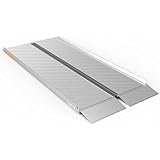 EZ-ACCESS Singlefold Wheelchair Ramp, 6 ft
Folds like a suitcase and carries in a car boot, so the same ramp handles the front step at home and the kerb at an appointment.
Check price on Amazon → Drive Medical Nitro Rollator with Seat
The seat matters more than the wheels. Being able to stop and rest is what decides whether someone still goes out at all.
Check price on Amazon → Vive Stand Assist Rail for Couch or Chair
Getting out of a low sofa is where most falls at home start. This is the cheapest thing on the list and often the first one needed.
Check price on Amazon →As an Amazon Associate we earn from qualifying purchases, at no extra cost to you. Researched guidance, not medical advice. Prices change, so check before buying.
Medicaid Overview
Who Qualifies
- Very low income AND limited assets
- Rules vary by state
- Many states cover elderly with income up to about $2,800/month (2025)
- Asset limits typically around $2,000 (not counting home, one car)
- Married couples have different rules
What Medicaid Covers
- Long-term nursing home care (the major difference)
- Home and community-based services
- Personal care assistance
- Doctor visits and hospital stays
- Prescription drugs
- Dental, vision, hearing (varies by state)
If your parent needs ongoing nursing home care, the kind where they live there because they can't care for themselves, Medicaid is typically the only coverage option unless they can pay privately (often $8,000-15,000/month).
Medicare vs Medicaid: Key Differences
| Feature | Medicare | Medicaid |
|---|---|---|
| Based on | Age (65+) or disability | Financial need (income/assets) |
| Run by | Federal government | State governments (with federal rules) |
| Coverage | Same nationwide | Varies by state |
| Nursing home | 100 days max (skilled only) | Covers long-term custodial care |
| Home care | Limited skilled home health | Extensive home/community services |
| Premiums | Yes (Part B, D, some plans) | Little to none |
| Apply through | Social Security | State Medicaid office |
Dual Eligibility: Having Both
Many elderly people qualify for both Medicare and Medicaid. This is called "dual eligibility" and provides comprehensive coverage:
- Medicare covers doctors, hospitals, Part D drugs
- Medicaid covers what Medicare doesn't (long-term care, premiums, copays)
- Medicaid may pay Medicare premiums and cost-sharing
- Special Dual-Eligible plans combine both
Programs like Medicare Savings Programs (QMB, SLMB, QI) help low-income Medicare beneficiaries with premiums and cost-sharing. Apply through your state Medicaid office even if you don't think you qualify for full Medicaid.
Qualifying for Medicaid
Income Limits
- Varies by state and type of coverage
- For nursing home care: many states allow income up to ~$2,800/month
- If income is higher, "spend-down" may be required
- Income counts: Social Security, pension, other regular income
Asset Limits
- Typically $2,000 for individual (varies by state)
- Exempt assets: primary home (to a limit), one car, personal belongings, prepaid burial
- Married couples: spouse at home keeps more assets (Community Spouse Resource Allowance)
The Look-Back Period
- Medicaid looks at 5 years of financial history
- Gifts or transfers for less than fair value may cause penalty
- Penalty = period of ineligibility for Medicaid
- This is complex, consult an elder law attorney
Medicaid fraud is a federal crime. Attempting to hide assets or transfer them to family to qualify for Medicaid can result in denial of benefits, penalties, and legal consequences. Work with an elder law attorney for legitimate planning strategies.
Common Scenarios
Scenario 1: Parent Needs Nursing Home Care
- Medicare covers first 100 days (if they meet skilled care criteria)
- After that, private pay or Medicaid
- Private pay: $8,000-15,000+/month
- Once assets depleted to Medicaid limit, apply for Medicaid
Scenario 2: Parent Needs Home Care
- Medicare covers limited skilled home health (not custodial)
- Medicaid may cover home and community-based services
- Many states have waiver programs for home care
- Private pay for ongoing personal care aides
Scenario 3: Parent Is Low-Income With Medicare
- May qualify for Medicaid as secondary coverage
- May qualify for Medicare Savings Programs (help with premiums/copays)
- May qualify for Extra Help (Low-Income Subsidy) for Part D drugs
- Apply through state Medicaid office
How to Apply
For Medicare
- Automatic enrollment at 65 if receiving Social Security
- Otherwise, apply through Social Security (ssa.gov or 1-800-772-1213)
- Initial enrollment period: 3 months before to 3 months after 65th birthday
- Late enrollment penalties apply for Part B and D
For Medicaid
- Apply through your state's Medicaid office
- Can apply online in many states
- Need documentation: ID, income proof, asset information, bills
- Hospital social workers can help with applications during crisis
- Elder law attorneys can assist with complex situations
Organize Benefit Information
Our Estate Planning Workbook helps you document Medicare and Medicaid information, track applications, and organize the paperwork needed.
Get the Complete Caregiver Kit- Medicare = age-based (65+); Medicaid = need-based (low income/assets)
- Medicare does NOT cover long-term nursing home care
- Medicaid DOES cover nursing home care for those who qualify
- Many elderly people have both (dual eligibility)
- Medicaid rules vary by state
- There's a 5-year "look-back" for asset transfers
- For complex situations, consult an elder law attorney