Bathroom Safety · Shower Wheelchairs · 8 Picks
Best Shower Wheelchairs for Elderly Parents (2026): 8 OT-recommended picks.
For parents who can't stand to transfer, the rolling shower chairs and mobile commode wheelchairs that home health agencies, occupational therapists, and rehab clinics actually buy. From $200 entry-level to $1,500 premium.
By The ParentCareGuide editorial team
Reviewed by ParentCareGuide editors
UPDATED 2026
10 MIN READ
How we choose what to recommend.
ParentCareGuide is editorially independent. Our picks come from published-spec research, consultation with occupational therapists, and verified buyer-review patterns at 4.0+ stars across 500+ reviews. We are not paid by manufacturers for placement and have not received free product from any brand listed.
Disclosure: when you click an Amazon link and buy, we earn a small commission at no cost to you, typically 2–4%. That's how we keep this work going.
How we choose → · Full disclosure →
Shower wheelchair vs. shower chair: when do you actually need one?
A regular shower chair stays in the shower. Your parent walks in (with help) and sits down to bathe. It works if they can step over a tub wall or walk into a roll-in shower.
A shower wheelchair rolls. Your parent transfers to it in the bedroom or hallway, and the caregiver pushes them into the shower without standing. Many include a commode opening so the same chair works over the toilet, eliminating one transfer per use.
Choose a shower wheelchair when: your parent can't stand to transfer; the bathroom is too small for safe standing transfers; you're doing 2+ transfers per shower; the parent is recovering from surgery; or fatigue is the main barrier to daily bathing.
Measure before you buy: 3 critical dimensions.
- Door width: measure the narrowest doorway the chair must pass through (bathroom door, hallway corners). Most shower wheelchairs are 22-26 inches wide. Standard residential doors are 28-32 inches.
- Shower entry width: for roll-in showers, measure the entry. For tub showers, you'll need a transfer bench instead (see our transfer bench guide).
- Turn radius: measure the open floor area where the wheelchair must turn (bathroom, in front of shower). Most shower wheelchairs need 36-44 inches of clearance to turn 90°.
All 8 shower wheelchairs at a glance.
· · ·
The picks, ranked by OT criteria.
EDITOR'S PICK
01

PREMIUM · OT STANDARD
Etac Clean Shower Commode Chair
The OT-recommended standard. Ergonomic, easy-to-clean frame, removable armrests for side transfers, ergonomic footrest, and a pan holder for dual bath/toilet use. Slim design fits through residential doorways. Designed for clinical-grade durability in nursing facilities and home use.
Price shown when last checked; see Amazon for current pricing.
02

CLINICAL-GRADE · ADVANCED
Etac Swift Mobil Tilt-2 Shower Commode
Tilt-and-recline design for users who can't sit upright safely. Used in advanced rehab. 353 lb capacity, adjustable armrests and headrest for comfortable bathing and toileting, commode opening. Overkill for most aging-parent use, but the right answer for complex needs.
Price shown when last checked; see Amazon for current pricing.
BARIATRIC PICK
03

BARIATRIC · 400 LB
Drive Medical Bariatric Rehab Shower Commode
The clinic-grade pick for bariatric users. Reinforced aluminum rehab frame (the NRS185008), wide reinforced seat, two rear-locking casters, padded seat with commode opening. Most home-health agencies stock these for users over 300 lbs.
Price shown when last checked; see Amazon for current pricing.
04

SELF-PROPELLED
HygiVital Self-Propelled Shower Commode
For parents who can self-propel: 22-inch rear wheels with hand rims let the user move themselves like a manual wheelchair. Waterproof anti-corrosion frame, swivel armrests, padded seat with commode opening. Good for retained upper-body strength.
Price shown when last checked; see Amazon for current pricing.
05

RECLINING MID-RANGE
Vive Reclining Shower Chair with Wheels
The mid-range pick when comfort and hair-washing matter. Reclining backrest, padded transfer seat with commode opening, waterproof frame, swing-away arms. Solid build for the price; the recline makes longer showers and rinsing easier for a frail parent.
Price shown when last checked; see Amazon for current pricing.
06

MID-RANGE VALUE
NOVA Rolling Shower Commode Chair
A solid mid-range pick at a notable price drop from clinical brands. Rolls over the toilet, locking wheels, removable footrests, padded seat with commode opening. Aluminum frame (expect oxidation over 2-3 years). Best for shorter-term use or recovery periods.
Price shown when last checked; see Amazon for current pricing.
07

LIGHTWEIGHT ENTRY
Vive 3-in-1 Commode Shower Chair
Lightweight 3-in-1 entry-level pick: bathroom, bedside, and over-toilet use in one chair. Rolling frame with locking wheels, padded seat, swing-away arms and footrest, removable bucket. Best for caregivers transitioning from a fixed shower chair who want wheels and a commode option.
Price shown when last checked; see Amazon for current pricing.
BEST VALUE
08
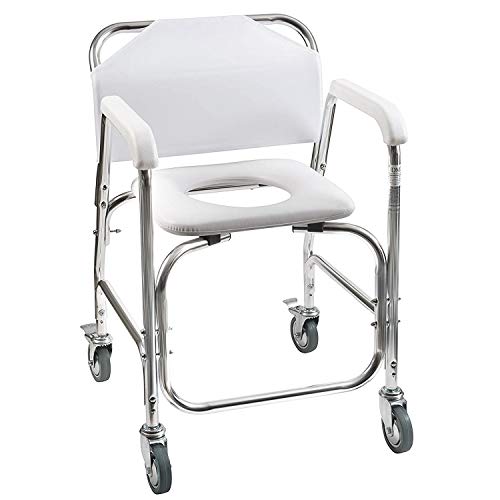
VALUE PICK · ENTRY-LEVEL
DMI Rolling Shower Commode Chair
The starting point for most caregivers. Aluminum frame, padded seat with commode opening, locking wheels, FSA eligible. Doubles as a transport chair. Adequate for short-term recovery or under-250 lb users. Not for daily long-term use.
Price shown when last checked; see Amazon for current pricing.
Accessories worth buying with the chair.
Affiliate disclosure. The product picks above are Amazon affiliate links. ParentCareGuide earns 2–4% commission when you buy through them, at no extra cost to you. We are editorially independent, manufacturers do not pay us for placement and we did not receive free product from any brand listed. Read our full disclosure →
Frequently Asked Questions
What is a shower wheelchair and how is it different from a shower chair?
A shower wheelchair is a mobile chair on wheels designed to roll into the shower or over the toilet. Unlike a fixed shower chair, a shower wheelchair transfers the user from bedroom to bathroom to shower without needing to stand. Many include a commode opening for dual bath/toilet use.
How wide should a shower wheelchair be?
Measure the narrowest doorway and shower entry it needs to fit through. Most shower wheelchairs are 22-26 inches wide; standard residential bathroom doorways are 28-32 inches. Bariatric shower wheelchairs (300+ lb capacity) can be 28-32 inches wide and may require door widening.
Are shower wheelchairs covered by Medicare?
Original Medicare typically does not cover shower wheelchairs because they are not classified as durable medical equipment. Some Medicare Advantage plans include a bathroom-safety benefit. Most caregivers pay out of pocket or use FSA/HSA funds. The IRS allows shower wheelchairs as medical expense deductions when prescribed.
Do shower wheelchairs rust?
The cheapest models rust within 6-12 months. Look for 304-grade stainless steel frames or polymer composites. Aluminum is acceptable but oxidizes over time. Avoid chrome-plated steel for any wet-use application.
Can a shower wheelchair be used over a toilet?
Yes, if it has a commode opening and the wheelbase allows it to roll over the toilet. Models marketed as "shower commode" chairs typically work over standard toilets. Always measure toilet height (standard 14-15 inches), wheelchair seat height, and clearance under the wheelchair before purchase.
What weight capacity should I look for?
Standard shower wheelchairs support 250-300 lbs. Bariatric shower wheelchairs support 400-600+ lbs. Always size up, pushing a shower wheelchair at the limit of its weight rating accelerates frame fatigue and brake failure, both critical safety hazards in a wet environment.
Related Bathroom Safety Guides
One more time, because this matters. Every product recommendation on this page is independent. We accept no manufacturer payment, no sponsored placement, and no free product in exchange for coverage. When you buy through an Amazon link here, we earn 2–4% commission, that's how we keep ParentCareGuide free to read. If a pick stops being our honest recommendation, we remove it. Our editorial standards → · Affiliate disclosure →
References & Sources
- Centers for Disease Control and Prevention. Falls in the Bathroom. CDC Injury Prevention.
- American Occupational Therapy Association. Bathing and Showering: Activities of Daily Living. AOTA Practice Guidelines.
- Internal Revenue Service. Publication 502: Medical and Dental Expenses. IRS.
- National Institute on Aging. Home Safety for Older Adults. NIA.


