The right mobility aid can mean the difference between independence and confinement, between staying home and needing facility care. But the wrong device, or the right device used incorrectly, can actually increase fall risk. Here's what you need to know.
Types of Mobility Aids
Standard Cane
A single-point cane provides light support and is easiest to use. Requires good balance and arm strength.
Pros
- Lightweight, portable
- Works on stairs
- Inexpensive
- Low learning curve
Cons
- Limited support
- Can't bear much weight
- Requires one free hand
- Not for significant weakness
Quad Cane (Four-Point Cane)
Has four small feet at the base, providing more stability than a standard cane. Stands on its own.
Pros
- More stable than single-point
- Stands independently
- Good for stroke recovery
Cons
- Heavier
- Awkward on stairs
- Slower pace
- More expensive
Standard Walker (No Wheels)
Four-legged frame that must be lifted with each step. Provides excellent stability but requires arm strength.
Pros
- Very stable
- Good weight-bearing support
- Won't roll away
- Relatively inexpensive
Cons
- Must lift with each step
- Slow walking pace
- Requires arm strength
- Difficult outdoors
Two-Wheel Walker
Front wheels with rear legs that slide. Combines stability with easier movement than a standard walker.
Pros
- Easier forward motion
- Doesn't roll backward
- More natural gait
Cons
- Less stable than no-wheel
- Rear legs can catch
- May be noisy indoors
Rollator (Four-Wheel Walker)
Four wheels with hand brakes and a built-in seat. Great for longer distances and those who tire easily.
Pros
- Smooth rolling motion
- Built-in seat for rest
- Often has basket/pouch
- Good for outdoors
Cons
- Less stable (can roll)
- Requires brake coordination
- Heavier, bulkier
- More expensive
Transport Wheelchair
Lightweight wheelchair pushed by a caregiver. User cannot self-propel. Great for outings and appointments.
Pros
- Very lightweight
- Folds compactly
- Easy to transport
- Affordable
Cons
- Can't self-propel
- Requires caregiver
- Small wheels, limited terrain
Manual Wheelchair
Standard wheelchair with large wheels that user can push themselves. More independent than transport chair.
Pros
- User can self-propel
- Independence at home
- Various sizes/features
Cons
- Heavier than transport
- Larger to transport
- Requires arm strength
Power Wheelchair/Scooter
Motorized mobility for those who can't use manual options. Scooters are for outdoors; power chairs work everywhere.
Pros
- No physical exertion needed
- Longer distances possible
- Preserves energy for other activities
Cons
- Expensive
- Heavy, hard to transport
- Home modifications needed
- Battery maintenance
As an Amazon Associate, we earn from qualifying purchases.
Recommended Mobility Aids
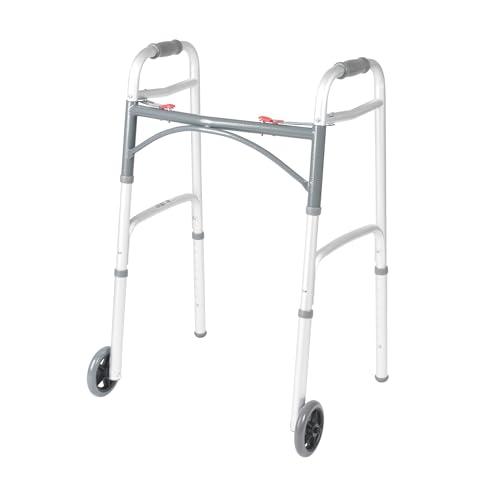 Drive Medical Folding Walker Lightweight aluminum walker with adjustable height and two-button release
 Hugo Mobility Quad Cane Stable quad-point base with ergonomic handle for comfortable support
 NOVA Rollator Walker with Seat Includes padded seat, storage pouch, and easy-lock brakes for rest breaks
 Drive Medical Lightweight Transport Chair Folds flat for easy transport, perfect for doctor visits and outings
Proper Sizing and Fit
Cane Height
With shoes on and arm at side, the cane handle should be at wrist level. When holding the cane, elbow should bend at about 15-20 degrees. Most canes are adjustable.
Walker/Rollator Height
Handles should be at wrist height when arms hang relaxed. Elbows should bend 15-20 degrees when gripping handles. Back should be straight, not hunched over.
Wheelchair Fit
Seat width: 2 inches wider than hips. Seat depth: 2-3 inches shorter than thigh length. Footrests: thighs parallel to floor, knees at 90 degrees. Back height: supports to below shoulder blades.
Proper Use Techniques
Using a Cane
Hold in the correct hand
Hold the cane on your STRONGER side, opposite the weak leg. This is counterintuitive but biomechanically correct.
Move cane with weak leg
Step forward with the cane and weak leg together, then follow with the strong leg.
Stairs with cane
Going UP: strong leg first, then cane and weak leg together. Going DOWN: cane and weak leg first, then strong leg. "Up with the good, down with the bad."
Using a Walker
Stay inside the walker
Don't lean forward over it. Walk "into" the walker with small steps. The walker should frame you, not be in front of you.
Lift, don't push
For standard walkers: lift the walker, set it down, then step. Don't slide it forward, this reduces stability.
For rollators: use the brakes
Always lock brakes before sitting on the seat. Squeeze brakes when stopping. Don't use the rollator like a shopping cart.
Medicare Coverage
What Medicare Covers
- Canes: Covered under Part B with doctor's prescription
- Walkers: Covered under Part B (basic models) with prescription and documented medical necessity
- Manual wheelchairs: Covered if needed for use in the home and prescribed by doctor
- Power wheelchairs: May be covered if manual wheelchair can't be used and a face-to-face evaluation is done
- Scooters: Limited coverage; must be medically necessary for in-home use
How to Get Medicare Coverage
- Get a prescription from the doctor stating medical necessity
- Use a Medicare-enrolled supplier (durable medical equipment supplier)
- For power wheelchairs: face-to-face evaluation and documentation required
- Expect to pay 20% of Medicare-approved amount after deductible
- Rental vs. purchase rules may apply
When to Consider Additional Support
A mobility aid isn't always enough. Consider additional help if your parent:
- Falls even with the mobility aid
- Can't safely use the device (forgetting brakes, using incorrectly)
- Is exhausted after basic mobility
- Needs more support than the current device provides
- Has progressing condition requiring increasing support
Track Mobility Changes
Our daily care log helps you document mobility changes, falls, and equipment needs.
Get the Care Coordination Binder