How we choose what to recommend.
ParentCareGuide is editorially independent. Picks come from published-spec research and verified buyer-review patterns at 4.0+ stars across 200+ reviews. We are not paid by manufacturers for placement and have not received free product from any brand listed.
Disclosure: Amazon affiliate links, we earn 2–4% commission at no extra cost. How we choose → · Affiliate disclosure →
Our top pick is the CURABOX Wi-Fi Automatic Pill Dispenser (under $250): for seniors managing multiple medications at different times of day, this automated dispenser is the most reliable way to prevent missed doses and double-dosing while giving caregivers the remote monitoring visibility they need. For seniors with simpler medication schedules, we have excellent lower-cost options below.
Medication errors are one of the most preventable causes of serious health complications in older adults. About half of seniors don't take their medications as prescribed, and the consequences range from uncontrolled blood pressure to avoidable hospitalizations. The right tool for your parent depends entirely on their situation and how much support they need.
A $8 weekly pill organizer is enough for some seniors. An automatic dispenser with caregiver alerts is essential for others. The key question is: does your parent reliably take their medications, or is there a pattern of missed doses? The answer tells you exactly which category of solution you need.
Quick Comparison: All 8 Products at a Glance
| Product | Price | Automated | Alerts You | Alarm | Best For |
|---|---|---|---|---|---|
| CURABOX Wi-Fi | Under $250 | Yes | Yes | Yes | Best overall auto |
| LiveFine Smart WiFi | Under $250 | Yes | Yes | Yes | WiFi caregiver alerts |
| EZY DOSE Weekly | Under $25 | No | No | No | Best budget organizer |
| Sagely Active | Under $50 | No | No | App reminder | Best smart organizer |
| MEDca Monthly | Under $25 | No | No | No | Monthly overview |
| EziMedPil Auto | Under $100 | Yes | No | Yes | One-time auto buy |
| Tabtime Watch | Under $25 | No | No | Vibrating watch | Discreet reminder |
| Windtrace Auto | Under $50 | Yes | No | Yes | Mid-range auto |
Which Medication Dispenser Is Best for Seniors Who Miss Doses?
1. CURABOX Wi-Fi Automatic Pill Dispenser
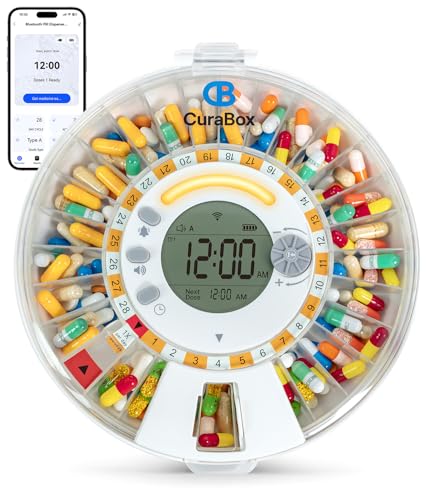
The CURABOX Wi-Fi dispenser is a countertop device that holds up to 28 days of supply across individual compartments. At the scheduled dose time, it flashes, sounds an alarm, and releases only the correct dose into a tray, locking all other compartments to prevent double-dosing. If your parent does not retrieve the dose, you receive an alert through the companion app.
Setup is through a smartphone app, and you can adjust schedules and view adherence history remotely over Wi-Fi. There is no subscription. For caregivers managing a parent's medications from a distance, the remote visibility CURABOX provides is genuinely valuable.
Pros
- Automatic dispensing prevents wrong-dose errors
- Wi-Fi caregiver app with missed-dose alerts
- Tracks adherence history remotely
- Key lock secures all other compartments
- No monthly subscription
- Clear LCD display with visual and audio alerts
Cons
- Requires Wi-Fi for remote alerts
- Highest upfront cost on our list
- Requires refilling every few weeks
- Not suitable for liquid or injectable medications
Is a Lower-Cost WiFi Dispenser Worth It?
2. LiveFine Smart WiFi Automatic Pill Dispenser
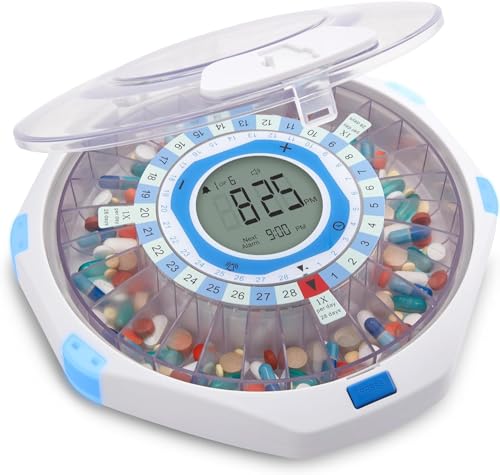
The LiveFine Smart WiFi dispenser delivers the same core benefit as our top pick at a lower price. It holds 28 days of medication, supports up to 9 doses per day, and uses Wi-Fi to send caregiver alerts when a dose is missed. A locking key keeps all other compartments closed until the next scheduled dose, and adjustable light and sound alarms prompt your parent at each dose time.
The lower price comes with a slightly simpler app and display than the CURABOX. For straightforward family-managed care over home Wi-Fi, LiveFine Smart WiFi is the better value; if you want the most polished adherence tracking, step up to the CURABOX.
Pros
- Wi-Fi remote monitoring at a lower price
- Caregiver missed-dose alerts
- Up to 9 doses per day
- Locking key prevents double-dosing
- Adjustable light and sound alarms
Cons
- Requires home Wi-Fi for alerts
- Simpler app than CURABOX
- Requires refilling every few weeks
Is a Simple Weekly Pill Organizer Enough?
3. EZY DOSE Weekly Pill Organizer

The EZY DOSE Weekly Pill Organizer is a no-frills, dependable pill organizer with seven day columns and four daily compartments (AM, Noon, PM, Bedtime). It has extra-large, arthritis-friendly push-button lids and costs under $25. For a senior who takes consistent medications at predictable times and simply needs a visual reference to confirm they have taken their dose, this works perfectly well.
No app required, no monthly fee, no setup. The EZY DOSE is the right answer when your parent's medication schedule is simple and they are cognitively intact. It is not the right answer if doses are frequently missed or if the schedule is complex.
Pros
- Extremely affordable (under $25)
- Easy-open push-button compartments
- 4 doses per day capacity
- Color-coded days
- No app or Wi-Fi needed
Cons
- No alarms or reminders
- No caregiver visibility
- Relies entirely on your parent's memory
What Makes the Sagely Active the Best App-Connected Organizer?
4. Sagely Active Weekly Pill Organizer

The Sagely Active bridges the gap between a basic organizer and a full automatic dispenser. It uses seven magnetic removable pods (AM and PM) that are easy to grip and open, which helps seniors with arthritis. The free companion app (available for iOS and Android) lets you set medication reminders and receive a notification if a dose is skipped, with no monthly fee.
The organizer does not dispense pills automatically, so your parent still needs to open the right pod. But the app-based reminder system significantly reduces missed doses for tech-comfortable seniors. It is the best middle-ground option at under $50.
Pros
- Free app reminders with no monthly fee
- Magnetic removable pods, arthritis-friendly
- Skipped-dose notifications via app
- Spill-proof, durable build quality
- One-time cost (under $50)
Cons
- Not automatic, parent must open compartment
- Requires smartphone for full functionality
- Less oversight than a Wi-Fi automatic dispenser
When Does a Monthly Pill Box Make Sense?
5. MEDca Monthly Pill Organizer

The MEDca Monthly Pill Organizer holds a full month of medication in individual labeled compartments. It is designed for seniors who take a single daily medication and need a clear visual reminder of whether they have taken that day's dose. At under $25, it is cost-effective and straightforward.
Its limitation is the same as any manual organizer: it does not remind, alert, or notify. For a senior with a once-daily medication who simply loses track of whether they took their pill, the visual check of "is today's compartment empty?" is often enough. For anything more complex, upgrade to the Sagely Active or an automatic dispenser.
Pros
- 31-day visual overview
- Affordable (under $25)
- Clear date labeling
- Compact design
Cons
- Once-daily capacity only
- No reminders or alarms
- No caregiver visibility
Is the EziMedPil Automatic Dispenser a Good Low-Cost Alternative?
6. EziMedPil Automatic Pill Dispenser

The EziMedPil Automatic Pill Dispenser offers automatic dispensing, alarms, compartment locking, dose-by-dose release, without a subscription fee. At under $100 as a one-time purchase, it is the most budget-friendly way to add real automation, holding 28 days of doses in a locked tray.
The trade-off is that EziMedPil does not have a caregiver app or remote monitoring capability. It will alarm with sound and light if a dose is missed, but it will not send a notification to your phone. For families who are in close contact with their parent (or nearby), this is a very cost-effective automatic dispensing option. For long-distance caregivers, the Wi-Fi alerts on the CURABOX or LiveFine Smart WiFi are worth the higher price.
Pros
- No monthly subscription
- Automatic dispensing with dose locking
- Audible and visual alarms
- One-time cost (under $100)
- Easy to refill
Cons
- No caregiver app or remote monitoring
- No missed-dose notification to you
- Higher upfront cost than basic organizers
Who Is the Tabtime Vibrating Watch Best For?
7. Tabtime Vibrating Reminder Watch

The Tabtime Vibrating Watch is not a pill organizer, it is a programmable wristband that vibrates silently at set medication times. For seniors who are active, social, and would be embarrassed by a loud pill alarm going off in public, the discreet vibration cue on the wrist is a practical alternative.
It supports up to 10 programmable alarms per day, has an easy-to-read display, and is simple to operate. It does not hold pills, does not automate dispensing, and does not alert caregivers. It is purely a personal reminder tool, excellent at that specific job.
Pros
- Discreet vibrating reminder
- Up to 10 programmable alarms/day
- Wearable, works away from home
- One-time cost (under $50)
- Good for active, social seniors
Cons
- No pill organization or dispensing
- No caregiver alerts
- Relies on parent to actually take pills after reminder
How Does the Windtrace Dispenser Compare as a Mid-Range Automatic Dispenser?
8. Windtrace Automatic Pill Dispenser

The Windtrace Automatic Pill Dispenser holds 28 compartments, dispenses pills at programmed times, and locks all other compartments. The alarm is loud, with a light reminder, and continues until the dose is taken.
It lacks the smartphone app connectivity of the CURABOX, but at under $50 as a one-time purchase, it is a reasonable mid-point between the basic EziMedPil and a Wi-Fi monitored dispenser. For seniors who need reliable automatic dispensing without ongoing monthly costs, and whose caregivers do not need remote monitoring, the Windtrace works well.
Pros
- One-time purchase (under $50)
- Automatic dispensing with dose locking
- Loud alarm and light reminder
- Simple on-device programming
Cons
- No smartphone app or caregiver alerts
- 28-compartment capacity means frequent refills
- No remote monitoring
How Do You Know Which Type of Medication Solution Your Parent Needs?
Start with these questions:
- Does your parent have cognitive impairment (dementia or memory loss)? If yes, go directly to an automatic dispenser with caregiver alerts, the CURABOX Wi-Fi or LiveFine Smart WiFi. A manual organizer is not adequate.
- How many medications and how many doses per day? One daily medication = a pill organizer works. Five medications at three different times = consider automation.
- Are you a long-distance caregiver? If you cannot check in person regularly, the caregiver app visibility in the CURABOX Wi-Fi or LiveFine Smart WiFi changes the equation substantially.
- Has your parent had a medication-related hospitalization or incident? That history suggests automatic dispensing is warranted regardless of other factors.
- Is the issue forgetfulness or refusal? Automatic dispensers address forgetfulness. If your parent is choosing not to take medications, the problem is different, see our guide on what to do when your elderly parent won't take medication.
The FDA estimates that medication errors contribute to roughly 125,000 deaths annually in the U.S. Among elderly adults, the most common errors are missed doses and taking the wrong dose due to confusion. An automatic dispenser with caregiver visibility is relatively inexpensive insurance against a preventable hospitalization.
Get the Medication Management Checklist
Our caregiver toolkit includes a complete medication tracking template, prescription organization guide, and doctor appointment preparation checklist.
Get the Caregiver Toolkit for $39Affiliate disclosure. The product picks above are Amazon affiliate links. ParentCareGuide earns 2–4% commission when you buy through them, at no extra cost to you. We are editorially independent, manufacturers do not pay us for placement and we did not receive free product from any brand listed. Read our full disclosure →
Frequently Asked Questions
The CURABOX Wi-Fi Automatic Pill Dispenser (under $250) is our top pick for seniors managing complex medication schedules, it dispenses the right pills at the right time and alerts caregivers over Wi-Fi if doses are missed, with no monthly subscription. For seniors with simpler needs, the Sagely Active organizer with free app reminders is a cost-effective alternative at under $50 with no monthly fee.
Automatic pill dispensers store medications in individual compartments. At the programmed time, the device alerts your parent with a sound or light and dispenses only the current dose, locking out other compartments to prevent double-dosing. Most connect to a caregiver app that notifies you if a dose is missed.
A simple pill organizer works if your parent has a consistent routine, takes only a few medications, and does not have cognitive impairment. An automatic dispenser is better for multiple medications at different times, a history of missed doses, cognitive decline, or when you want caregiver alerts. Cognitive impairment is the clearest indicator, for any parent with memory issues, automation is worth the cost.
For seniors managing 5+ medications across multiple daily doses, a Wi-Fi dispenser like the CURABOX (under $250) or LiveFine Smart WiFi (under $250) is generally worth the cost. The device eliminates missed doses, the most common medication error, and provides caregiver alerts with no monthly subscription. Compare that to the cost of a single medication-related ER visit. For seniors on simpler regimens, an under-$50 organizer with a phone alarm may be sufficient.
Both are Wi-Fi automatic dispensers with caregiver monitoring and no subscription. The CURABOX (under $250) has the more polished app and adherence-history tracking. The LiveFine Smart WiFi (under $250) costs less, supports up to 9 doses per day, and uses a slightly simpler app and display. The CURABOX is the premium pick; LiveFine Smart WiFi is the better value for straightforward family-managed home care.
Yes, monthly pill organizers like the MEDca Monthly Pill Organizer hold a full month of medication in individual daily compartments. They work well for seniors taking a single daily dose who need a visual reference for whether they have taken their medication. For multiple daily doses, a weekly organizer with multiple compartments per day is more practical.
The Sagely Active uses magnetic removable pods that are easy to grip and open compared to most competitors, making it a good choice for seniors with arthritis or reduced hand strength. The EziMedPil Automatic Dispenser eliminates the need to open compartments at all, as it dispenses pills automatically, which is the most arthritis-friendly automated option.
The most effective strategies are tying medication times to consistent daily routines (meals, bedtime), using a visual pill organizer so they can see whether the day's dose has been taken, setting phone alarms or using an organizer with app reminders like the Sagely Active, and for parents with cognitive impairment, moving to an automatic dispenser with caregiver alerts. Address any concerns about side effects, sometimes refusal to take medication is a communication about how the pills make them feel.