How we choose what to recommend.
ParentCareGuide is editorially independent. Picks come from published-spec research and verified buyer-review patterns at 4.0+ stars across 200+ reviews. We are not paid by manufacturers for placement and have not received free product from any brand listed.
Disclosure: Amazon affiliate links, we earn 2–4% commission at no extra cost. How we choose → · Affiliate disclosure →
Pressure sores, also called bedsores or pressure ulcers, can develop in as little as two hours in a bed-bound senior. Once they form, they are painful, slow to heal, and can lead to serious infection. The right pressure relief mattress pad is not a comfort item. For a parent with limited mobility, it is a medical necessity.
We researched eight of the most effective, best-reviewed pressure relief mattress overlays and alternating pressure pads available today, evaluating each for pressure redistribution, ease of use, noise level, durability, and value. Whether your parent is at low risk and needs basic cushioning or is fully bed-bound and requires clinical-grade alternating pressure, there is the right option in this review.
Quick Comparison: 8 Best Pressure Relief Mattress Pads 2026
| Product | Type | Best Risk Level | Price | Best For |
|---|---|---|---|---|
| Drive Medical Med-Aire | Alternating Pressure | High risk | Under $100 | Best overall alternating pressure |
| Vive Alternating Pressure | Alternating Pressure | High risk | Under $100 | Best value alternating pressure |
| ROHO Prodigy Overlay | Air Cell Overlay | High/Very high risk | Under $500 | Clinical-grade ROHO technology |
| Medline Gel Overlay | Gel Foam | Low–moderate risk | Under $250 | Gel comfort layer |
| ProHeal Low Air Loss | Alternating Pressure | High risk | Under $500 | Full mattress replacement option |
| Drive Med-Aire Low Air Loss | Alternating + Low Air Loss | Very high risk | Under $1,000 | Heavy-duty clinical use |
| Invacare Premier Foam | Foam Mattress | Low–moderate risk | Under $1,000 | Foam-based, quiet operation |
| DMI Foam Egg Crate | Egg Crate Foam | Low risk / comfort | Under $50 | Basic comfort, very low cost |
The 8 Best Pressure Relief Mattress Pads, Detailed Reviews
Drive Medical Med-Aire Alternating Pressure Pump & Pad
 Best for: Bed-bound seniors at high risk for pressure sores
The Drive Medical Med-Aire is a strong value standard for home alternating pressure systems. It works by cycling air in and out of alternating cell columns, constantly shifting the contact points between your parent's body and the mattress surface. This continuous pressure redistribution is among the most clinically effective methods of preventing pressure ulcers in non-mobile patients, and the Med-Aire delivers it reliably at a fraction of a nursing home level investment.
The quiet pump is a meaningful feature for overnight use, it operates at a noise level that doesn't disrupt sleep. Setup involves connecting the pad to the pump unit, which sits beside the bed, and laying the pad over the existing mattress. The pump includes a CPR release valve for emergencies. This is the system most home health nurses recommend when a family asks what to buy for a bed-bound parent.
Pros
- Clinically effective alternating pressure
- Quiet pump for overnight use
- Fits over existing mattress
- CPR valve for emergencies
- Trusted Drive Medical brand
Cons
- Pump requires electrical outlet
- Air cells can puncture with sharp objects
- Requires regular maintenance checks
Vive Alternating Pressure Mattress Pad
 Best for: High-risk patients where budget is a constraint
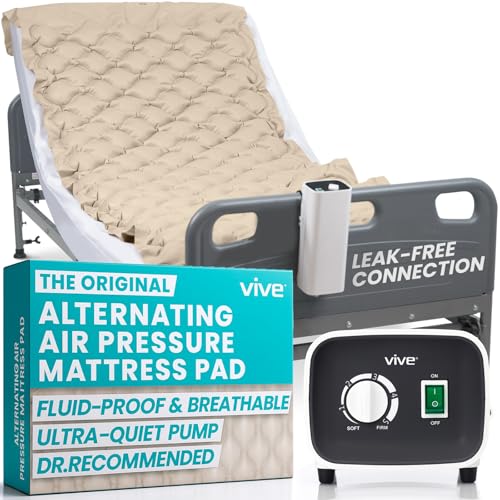
Vive's alternating pressure pad delivers the same core technology as clinical systems, cycling air cells to redistribute pressure every few minutes, with a waterproof breathable cover and a whisper-quiet pump included. For families managing tight care budgets while still needing solid pressure relief, the Vive is a genuine solution rather than a compromise, and a satisfaction guarantee adds confidence for a high-stakes purchase.
The pump operates quietly and the setup process is straightforward. The air cells are slightly less durable than premium systems, which means more careful management is needed to avoid punctures from bed rails or sharp objects. For a parent at high risk who will be closely monitored and repositioned regularly by a caregiver or home health aide, the Vive performs its primary job effectively.
Pros
- Affordable full pump-and-pad system
- Alternating pressure technology
- Waterproof breathable cover
- Whisper-quiet pump operation
Cons
- Air cells less durable than premium
- Not ideal for very high-risk patients alone
ROHO Prodigy Dry Floatation Mattress Overlay
 Best for: Very high-risk patients or existing pressure ulcer management
ROHO's interconnected air cell technology is used in clinical and rehabilitation settings worldwide, and the Prodigy overlay brings that same pressure management capability home. Rather than alternating pressure cycles, ROHO uses a system of interconnected air-filled cells that conform precisely to the body's contours, distributing weight across the widest possible surface area and essentially floating the body above the mattress. There is no heat, noise, or moving parts to fail.
At under $500, this is a serious investment, but for a parent with an existing Stage I or Stage II pressure ulcer, or for someone at very high risk due to full immobility, complete incontinence, and poor skin integrity, the ROHO's clinical performance justifies the cost. Talk to your parent's wound care nurse before purchasing to confirm whether this or an alternating pressure system is most appropriate.
Pros
- Clinical-grade pressure redistribution
- Used in hospitals and rehab centers
- No pump or electricity required
- Conforms precisely to body contours
- Appropriate for existing ulcer management
Cons
- High price at under $500
- Requires periodic inflation adjustments
- Air cells vulnerable to puncture
Medline Gel Foam Mattress Overlay
 Best for: Low to moderate risk seniors who need comfort-level pressure relief
For a parent who is mostly mobile but spends increased time in bed, recovering from illness, managing fatigue, or dealing with chronic pain, the Medline Gel Foam overlay provides meaningful pressure relief at a fraction of the cost of active systems. The 34 by 76 by 3 inch gel-infused foam layer conforms to body contours better than standard foam alone, reducing pressure at bony prominences like heels, hips, and shoulder blades where sores most commonly develop.
The Medline brand quality means the gel foam is consistent throughout the pad, not just on the surface, which matters for long-term effectiveness. No electricity or pump is needed, making setup completely silent and hassle-free. The overlay fits under a standard fitted sheet. This is not the right product for a fully bed-bound high-risk patient, but for moderate-risk seniors it provides clinically meaningful comfort improvement.
Pros
- No pump or electricity needed
- Completely silent
- Gel foam reduces peak pressure points
- Medline brand quality
- Affordable for foam/gel category
Cons
- Not appropriate for high-risk patients
- Foam compresses over time with heavy use
- Not a substitute for repositioning
ProHeal Low Air Loss Alternating Pressure Mattress
 Best for: Families replacing an existing mattress entirely for a bed-bound parent
Where most alternating pressure products are overlays placed on top of an existing mattress, the ProHeal Low Air Loss system is a full mattress replacement, appropriate when a parent's existing mattress is worn, sagging, or no longer provides adequate support as a base layer. The ProHeal includes a full-depth 8-inch alternating pressure mattress with an integrated digital pump, targeting bed sores at Stages I to III.
At under $500 it costs more than the overlay systems in this review but less than the high-end clinical options. For families setting up a dedicated care bed, especially if a hospital bed has been delivered and lacks a quality mattress, the ProHeal is a complete, well-reviewed solution. The pump is designed for continuous operation with pressure settings for different weight ranges.
Pros
- Complete mattress replacement
- Integrated pump, no separate overlay
- Weight-adjustable pressure settings
- Designed for 24-hour continuous use
Cons
- Requires discarding existing mattress
- Pump requires continuous electricity
- Larger upfront investment
Drive Medical Med-Aire Low Air Loss Mattress System
 Best for: Very high-risk patients requiring maximum clinical-level pressure relief at home
The Drive Medical Med-Aire Low Air Loss Mattress Replacement System combines alternating pressure with continuous low air loss, which manages both pressure and surface moisture, an important distinction for a parent who is fully immobile, has existing skin fragility, or has experienced pressure ulcers previously. The 84 by 36 inch system replaces the mattress and is built for heavy-duty continuous operation.
At under $1,000, this is a significant investment. But for families managing a parent whose pressure ulcer risk is monitored by a wound care nurse or physician, a clinical-caliber low-air-loss system at home can extend the period your parent can remain safely at home rather than requiring facility care. Consult your parent's medical team before purchasing.
Pros
- Alternating pressure plus low air loss
- Manages moisture at the skin surface
- Full mattress replacement system
- Built for continuous heavy operation
Cons
- Highest cost in this review at under $1,000
- Louder pump than basic consumer pads
- Medical guidance strongly recommended before purchase
Invacare Premier Foam Mattress
 Best for: Moderate-risk seniors where noise from a pump is a concern
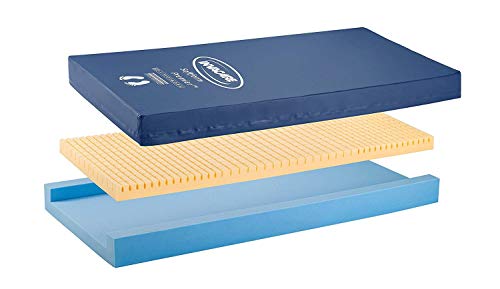
The Invacare Premier is a high-density foam mattress that provides meaningful pressure redistribution through contouring foam rather than active air cycling. For a parent at moderate pressure ulcer risk, someone who repositions with assistance but is not fully immobile, its quiet, pump-free operation is a genuine advantage. The cover is fluid-resistant and the firmer mid-section with softer head and feet sections plus enhanced side support helps with safe transfers.
Invacare is a trusted clinical brand and the Premier's foam density is calibrated for pressure management rather than just comfort, a meaningful distinction from a standard memory foam topper. At under $500 it sits between budget foam overlays and active alternating pressure systems, appropriate for moderate-risk situations and for replacing a worn hospital-bed mattress.
Pros
- Completely silent, no pump
- No electricity required
- Clinical-density foam, not just comfort foam
- Fluid-resistant cover
- Enhanced side support for transfers
Cons
- Not appropriate for high-risk patients
- Foam compresses over 12–18 months of heavy use
DMI Egg Crate Foam Mattress Pad
 Best for: Low-risk seniors needing basic comfort improvement
The DMI Egg Crate Foam pad is the entry point of pressure relief bedding, and it is important to be accurate about what it does and does not do. The convoluted foam surface reduces peak pressure at bony prominences compared to a standard flat mattress, making it a meaningful comfort upgrade for a parent who is mostly mobile but spending more time resting. At under $50 for this hospital-size 33 by 76 by 4 inch version, it is not a medical pressure ulcer prevention system and should never be used as the sole protection for a high-risk patient.
For a parent who is recovering from illness, gets up regularly, and is at low or no current risk of pressure sores, the DMI Egg Crate provides genuine comfort improvement without requiring any special setup. It lays flat over a mattress, compresses for storage, and costs less than a single doctor copay. Use it as a comfort layer, not a clinical solution.
Pros
- Very affordable at under $100
- Provides some pressure redistribution
- No setup required
- Good comfort improvement for low-risk users
Cons
- Not a medical pressure ulcer prevention system
- Not appropriate for high-risk patients
- Foam degrades faster than premium materials
- Difficult to clean thoroughly
Understanding Pressure Ulcer Risk Levels
Matching the right product to your parent's actual risk level is the most important decision in this category. Using an underpowered product for a high-risk patient is a genuine danger.
Low Risk
Mobile seniors who walk or reposition independently, spend limited time in bed, and have intact skin. A basic foam overlay like the DMI Egg Crate or a gel foam overlay like the Medline provides appropriate comfort improvement without clinical-grade pressure management.
Moderate Risk
Seniors who need assistance to reposition, spend 8 or more hours per day in bed, have compromised skin, or have diabetes or circulatory conditions. A clinical-density foam mattress like the Invacare Premier or a gel foam overlay is appropriate. Regular repositioning every 2 hours remains essential.
High Risk
Seniors who are fully bed-bound, cannot reposition independently, have incontinence, or have had previous pressure ulcers. An active alternating pressure system, such as the Drive Medical Med-Aire, Vive, ProHeal, or a low-air-loss system, is the medically appropriate standard of care. A pressure ulcer prevention program should be supervised by a clinician.
Medicare Coverage for Pressure Relief Mattress Pads
Medicare Part B may cover alternating pressure mattress pads and overlays as durable medical equipment when medical necessity is documented. Coverage typically requires:
- A physician order documenting Stage III or Stage IV pressure ulcers, or an at-risk patient who is completely immobile
- Purchase or rental through a Medicare-enrolled DME supplier
- Your parent pays 20% of the Medicare-approved amount after the Part B deductible
Affiliate disclosure. The product picks above are Amazon affiliate links. ParentCareGuide earns 2–4% commission when you buy through them, at no extra cost to you. We are editorially independent, manufacturers do not pay us for placement and we did not receive free product from any brand listed. Read our full disclosure →
Frequently Asked Questions
How long does it take for a pressure sore to develop?
In a high-risk patient, someone fully immobile, with fragile skin, incontinence, or poor circulation, a Stage I pressure ulcer can develop in as little as 1 to 2 hours of unrelieved pressure on bony prominences like heels, the sacrum, or shoulder blades. This is why alternating pressure systems and regular repositioning are critical for bed-bound seniors, not optional.
What is the difference between an alternating pressure pad and a foam overlay?
An alternating pressure pad uses a pump to cycle air in and out of cell columns, constantly changing which body areas bear pressure, preventing any single area from sustained compression. A foam overlay redistributes pressure passively by conforming to body contours. Alternating pressure is clinically superior for high-risk patients; foam overlays are appropriate for comfort improvement in low-to-moderate risk situations.
How noisy are alternating pressure pumps?
Quality alternating pressure pumps like the Drive Medical Med-Aire operate at approximately 30 to 40 decibels, similar to a quiet library or very soft background noise. Most parents and caregivers adjust to this ambient noise within a few nights. If noise is a major concern, consider a high-quality foam overlay for low-to-moderate risk patients and avoid the pump entirely.
Can a mattress pad replace repositioning?
No. Clinical guidelines are clear: pressure relief surfaces reduce risk but do not replace the need for regular repositioning. Bed-bound patients should be repositioned at minimum every 2 hours, with heel protection and proper body alignment maintained between turns. A pressure relief mattress pad is one component of a comprehensive skin care protocol, not a complete solution on its own.
Will a pressure relief pad fit my parent's hospital bed?
Most overlays are designed to fit standard twin or full-size mattresses and hospital beds. Confirm the dimensions of your parent's specific bed, particularly if they have a bariatric hospital bed or a non-standard frame, before purchasing. Some overlays are available in full/twin XL and wider sizes for bariatric beds.
Get the Complete Caregiver Toolkit
Includes pressure ulcer risk assessment checklists, repositioning schedules, wound care documentation templates, and 40+ more resources for caring for a bed-bound parent.
Get the Complete Toolkit for $39One more time, because this matters. Every product recommendation on this page is independent. We accept no manufacturer payment, no sponsored placement, and no free product in exchange for coverage. When you buy through an Amazon link here, we earn 2–4% commission, that's how we keep ParentCareGuide free to read. If a pick stops being our honest recommendation, we remove it. Our editorial standards → · Affiliate disclosure →